
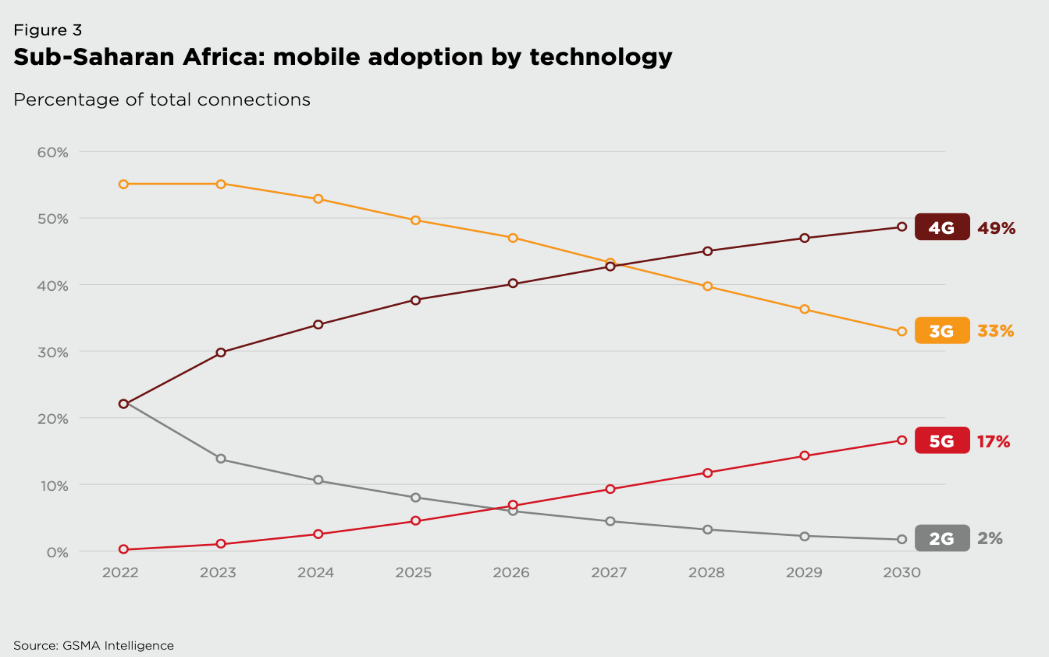
Moreover, 5G expansion in Sub-Saharan Africa is expected to progress steadily, contrasting with global trends. More users are shifting to 4G, almost doubling its subscriptions to reach 49% of total connections by the decade’s end. Meanwhile, projections suggest a decline in 2G and 3G connections to 2% and 33%, respectively, by 2030.
The Primary Beneficiaries of 5G
The primary beneficiaries of 5G are the industry and services sectors. According to the report by GSMA, 5G mobile networks are projected to contribute $11 billion to the economy of sub-Saharan Africa by 2030, a significant increase from the less than $1 billion recorded in 2022. While some countries in the region are still in the early stages of deploying 5G networks, the economic advantages are expected to grow with widespread adoption.
The impact of 5G is anticipated to extend across various sectors, depending upon their capacity to integrate the technology into their operations. By 2030, the manufacturing sector is expected to account for 32% of the economic impact, driven by applications like smart factories and cities. Additionally, the services sector, including public administration, financial services, healthcare, and education, is projected to contribute 29% to the economic impact.
The GSMA also highlights that the combined contribution of mobile telephony, encompassing all generations, to economic value added in sub-Saharan Africa is estimated to reach approximately $210 billion in 2030, a rise from $170 billion in 2022. This growth is attributed to increased productivity and efficiency resulting from expanded mobile service usage, primarily driven by the surge in 4G and 5G subscriptions.
On a regional scale, the total number of mobile network subscriptions (SIM connections) is expected to reach 1.36 billion in 2030, up from 980 million in 2022. The number of unique mobile network subscribers is anticipated to increase from 489 million in 2022 to 692 million in 2030. The mobile penetration rate in Sub-Saharan Africa is expected to reach 50% in 2030, compared to 43% in 2022.
Moreover, the smartphone adoption rate in the region is forecasted to reach 88% (1.2 billion smartphone connections) by the end of the current decade, compared to 51% in 2022, driven by improved financial accessibility to these devices.